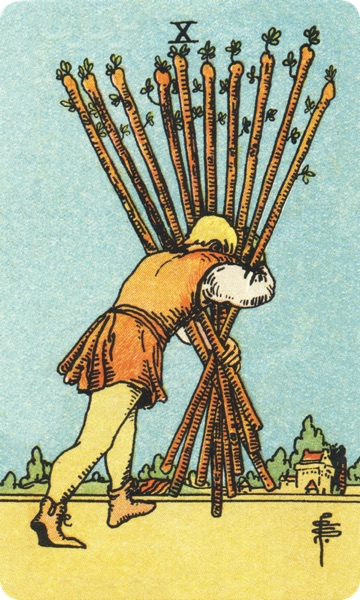

Ten of Wands Tarot Card Meaning (Suit of Wands)
Ten of Wands is the Wands card of success or duty becoming heavy enough to narrow vision. Upright, Ten of Wands means Burden, responsibility, pressure. Reversed, it means Excessive pressure, exhaustion. In modern tarot reading, Wands often carry fire-like themes of initiative, drive, creativity, and momentum, but this article treats that as interpretation rather than historical proof.
Quick Facts
| Item | Value |
|---|---|
| Card | Ten of Wands |
| Source ID | wands_9 |
| Suit | Wands |
| Rank | Ten / 10 |
| PKT text year | 1910 |
| Waite source page | 98 |
| Upright short meaning | Burden, responsibility, pressure |
| Reversed short meaning | Excessive pressure, exhaustion |
| Keywords | burden, pressure, responsibility, overload, completion |
Overview
Ten of Wands is a Minor Arcana card in the suit of Wands. Ten of Wands is a numbered Wands card, so it tracks how initiative develops through pressure, timing, and result. The internal English short meaning is the production anchor: upright means Burden, responsibility, pressure, and reversed means Excessive pressure, exhaustion.
Waite's 1910 Pictorial Key to the Tarot gives this upright anchor:
"The chief meaning is oppression simply, but it is also fortune, gain, any kind of success"
Biddy Tarot lists the upright keywords as "Burden, extra responsibility, hard work, completion". Labyrinthos supports the card through themes of burden, responsibility, duty, stress, obligation, burning out, struggles; reversed failure to delegate, shouldering too much responsibility, collapse, and breakdown. Chatarot uses those modern sources as interpretation support, not as prose to copy.
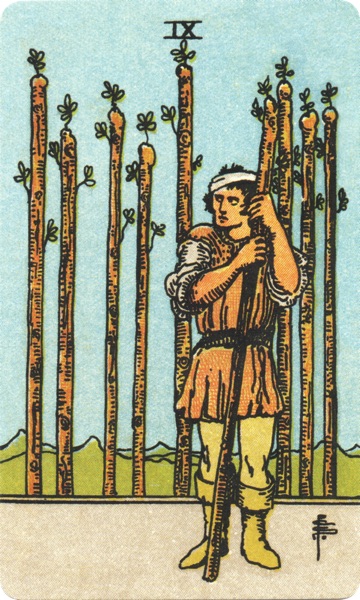
The Nine defends the boundary; the Ten asks whether carrying everything alone has become the problem. This keeps the Wands sequence from becoming one repeated story about ambition. Each card asks a different question about action: where it begins, how it moves, what it costs, and how it becomes responsible.
What does Ten of Wands mean upright?
Upright, Ten of Wands means Burden, responsibility, pressure. In a reading, it often points to success or duty becoming heavy enough to narrow vision. The card asks what kind of action is available now, and whether that action has enough direction to become useful.
Waite's wording keeps the historical texture visible. It may not match the modern short meaning perfectly, but it gives a concrete source anchor for the older divinatory tradition. Biddy and Labyrinthos support the more contemporary reading language used by English readers.
Practically, the upright card is not a command to push harder. It asks for the right relationship to energy: begin, plan, compete, defend, move, complete, learn, lead, or pause according to the card's place in the Wands sequence.
What does Ten of Wands mean reversed?
Reversed, Ten of Wands means Excessive pressure, exhaustion. The same Wands energy is still present, but it is blocked, rushed, scattered, overburdened, or poorly directed.
Waite gives the reversed wording as: "Contrarieties, difficulties, intrigues, and their analogies." Chatarot keeps that older wording separate from the internal short meaning so modern interpretation does not get laundered into the primary source.
A reversed Wands card usually asks where action has lost proportion. The answer may be patience, clearer planning, delegation, firmer boundaries, or simply refusing to confuse pressure with progress.
Ten of Wands in love, career, health, and money
Love
In love, Ten of Wands can point to one person carrying too much, emotional labor, or responsibility crowding out warmth. It should not be read as a fixed prediction about what another person will do. The useful question is how desire, initiative, conflict, confidence, or timing is shaping the relationship.
Reversed, the card can show the same theme under strain: hesitation, conflict avoidance, pressure, overreaction, or a loss of shared direction. Neutral language matters here; the reading should not assume gender roles or a single relationship model.
Do I keep carrying the emotional load or ask for shared responsibility?
 Star-Sleeping Girl · Sora·
 Crossroads of Fate
Career
In career readings, Ten of Wands can suggest overload, delivery pressure, too many commitments, or success that has become hard to carry. Wands are especially useful for questions about initiative, creative work, leadership, competition, and momentum.
Reversed, the card can show blocked action, rushed execution, unclear roles, or effort that no longer matches the goal. The practical response is to ask what kind of movement would actually help the work.
Why has my success turned into more work than I can carry?
 Mystic Poet · Selene Noir·
 Celtic Cross
Health
In health readings, Ten of Wands can symbolically point to energy, pacing, motivation, pressure, or the way a person relates to action and rest. In a tarot reading context, this is a symbolic reminder rather than medical advice.
Reversed, it may suggest symbolic strain, depletion, impatience, or the need to slow down and seek real support. Tarot should not be used to diagnose burnout, illness, or recovery.
Why do I fill every pause with another task instead of resting?
Star-Sleeping Girl · Sora· Mirror of Soul
Money
In money readings, Ten of Wands can describe financial pressure, too many obligations, or the need to distinguish responsibility from overextension. Because Wands often involve action and initiative, the card is useful for questions about earning, projects, spending impulses, and the confidence to move.
Reversed, it can warn against overextension, delay, scattered effort, or decisions made because pressure feels urgent. The card does not promise financial outcomes; it asks how energy is being used around resources.
How will reducing my financial obligations change my sense of pressure?
Mystic Poet · Selene Noir· Flow of Time
Rider-Waite-Smith imagery and symbols
The Rider-Waite-Smith image shows a figure carrying ten bundled wands toward a town or structure. The public-domain Commons image is used here for visible facts only. Symbolic meaning is interpretation unless a named source explicitly supports it.
Waite's image description and divinatory list give a useful check on modern keywords. When the older text differs from current search language, this article keeps the difference visible instead of pretending the tradition is unanimous.
The article uses conservative agency wording. It does not claim that Pamela Colman Smith created, added, or designed a specific symbol unless a source states that directly.
Historical and suit context
Ten of Wands belongs to the Wands suit, one of the four Minor Arcana suits in this project. The canonical English suit name is Wands, not Rods or Batons, even though older texts may use words such as staves or rods in descriptions.
In modern tarot practice, Wands are commonly read through action, initiative, creativity, ambition, and momentum. That is a reading convention, not a historical claim made by the Commons image page. Ten of Wands can mention burnout as a modern symbolic theme, but it should not diagnose a medical condition.
Interpretation notes
For production consistency, Ten of Wands should be differentiated from nearby Wands cards. The Nine defends the boundary; the Ten asks whether carrying everything alone has become the problem. The card's meaning should come from its rank, image, Waite anchor, and modern keyword support, not from a generic suit template.
For numbered Wands readings, this card should stay tied to the stage of action shown by its number. That keeps it distinct from the other numbered Wands cards.
FAQ
What does Ten of Wands mean upright?
Upright, Ten of Wands means Burden, responsibility, pressure. It usually points to success or duty becoming heavy enough to narrow vision in a way that asks for clearer action and proportion.
What does Ten of Wands mean reversed?
Reversed, Ten of Wands means Excessive pressure, exhaustion. It can show blocked, rushed, defensive, delayed, or overextended Wands energy, depending on the question.
Is Ten of Wands a yes-or-no card?
It is better read as a condition card than a simple yes or no. It describes the state of action, desire, pressure, or leadership around the question.
How is Ten of Wands different from nearby Wands cards?
The Nine defends the boundary; the Ten asks whether carrying everything alone has become the problem.
Sources and further reading
- Arthur Edward Waite, The Pictorial Key to the Tarot (1910), Wikisource proofread page, https://en.wikisource.org/wiki/Page:The_Illustrated_Key_to_the_Tarot.djvu/98
- Wikimedia Commons: Ten of Wands, Rider-Waite-Smith tarot, https://commons.wikimedia.org/wiki/File:Wands10.jpg
- Biddy Tarot: Ten of Wands Tarot Card Meanings, https://biddytarot.com/tarot-card-meanings/minor-arcana/suit-of-wands/ten-of-wands/
- Labyrinthos: Ten of Wands Meaning, https://labyrinthos.co/blogs/tarot-card-meanings-list/ten-of-wands-meaning-tarot-card-meanings