
Knight of Swords Tarot Card Meaning (Suit of Swords)
Knight of Swords is the Swords card of fast action, courage, argument, or a decisive push that needs discipline and context. Upright, Knight of Swords means Action, courage, change. Reversed, it means Recklessness, aggression, conflict. In modern tarot reading, Swords often relate to thought, conflict, truth, decisions, and communication, but this article treats that as interpretation rather than historical proof.
Quick Facts
| Item | Value |
|---|---|
| Card | Knight of Swords |
| Source ID | swords_11 |
| Suit | Swords |
| Rank | Knight / court |
| PKT text year | 1910 |
| Waite source page | 124 |
| Upright short meaning | Action, courage, change |
| Reversed short meaning | Recklessness, aggression, conflict |
| Keywords | action, courage, change, assertive, direct, impatient |
Overview
Knight of Swords is a Minor Arcana card in the suit of Swords. Knight of Swords can describe a person, role, energy, or mode of action; it is not limited to one gender or age. The internal English short meaning is the production anchor: upright means Action, courage, change, and reversed means Recklessness, aggression, conflict.
Waite's 1910 Pictorial Key to the Tarot gives this upright anchor:
"Skill, bravery, capacity, defense, address, enmity, wrath, war, destruction, opposition, resistance, ruin."
Biddy Tarot lists the upright keywords as "Ambitious, action-oriented, driven to succeed, fast-thinking". Labyrinthos supports the card with upright themes of assertive, direct, impatient, intellectual, daring, focused, and perfectionist; its reversed keyword basis includes rude, tactless, forceful, bully, aggressive, vicious, and ruthless. Chatarot uses those modern sources as interpretation support, not as prose to copy.
As a court card, the Knight can describe a person, role, energy, or mode of action rather than a fixed age or gender. Swords are useful when a question turns on language, strategy, evidence, boundaries, or the cost of a choice. This is a modern reading convention, not a historical claim made by an image file or a museum record.
What does Knight of Swords mean upright?
Upright, Knight of Swords means Action, courage, change. In a reading, it often points to fast action, courage, argument, or a decisive push that needs discipline and context. The card asks what is actually available now, what is being assumed, and what kind of next step would be proportionate to the question.
Waite's wording keeps the historical texture visible. It may not match the modern short meaning perfectly, but it gives a concrete source anchor for the older divinatory tradition. Biddy and Labyrinthos support the more contemporary reading language used by English readers, while Chatarot keeps those layers separate.
Practically, the upright card is not a command or a promise. It asks how the suit's theme is functioning in context: thought, conflict, truth, decisions, and communication. The answer may be action, patience, clearer language, better planning, stronger boundaries, or a more realistic view of the resources involved.
What does Knight of Swords mean reversed?
Reversed, Knight of Swords means Recklessness, aggression, conflict. The same Swords theme is still present, but it may be blocked, exaggerated, delayed, overused, or handled without enough context.
Waite gives the reversed wording as:
"Imprudence, incapacity, extravagance."
Chatarot keeps that older wording separate from the internal short meaning so modern interpretation does not get laundered into the primary source. In practice, the reversed card can suggest recklessness, force without listening, or conflict accelerated by speed and certainty. It asks where the reading needs more honesty, proportion, support, or timing.
Knight of Swords in love, career, health, and money
Love
In love, Knight of Swords can point to the way fast action, courage, argument, or a decisive push that needs discipline and context shapes connection, communication, trust, or timing. It should not be read as a fixed prediction about what another person will do. The useful question is how the people involved are handling choice, care, pressure, boundaries, or repair.
Reversed, the card can show the same theme under strain: recklessness, force without listening, or conflict accelerated by speed and certainty. Neutral language matters here; the reading should not assume gender roles, marriage, monogamy, or a single relationship model.
How can I move things forward without steamrolling the person I care about?
 Star-Sleeping Girl · Sora·
 Mirror of Soul
Career
In career readings, Knight of Swords can suggest fast action, courage, argument, or a decisive push that needs discipline and context in work, study, leadership, conflict, planning, or responsibility. Swords cards are useful for work questions when they are kept specific to the actual context rather than turned into a generic success or failure script.
Reversed, the card can show blocked movement, unclear expectations, rushed judgment, weak follow-through, or pressure that needs a better structure. The practical response is to ask what kind of next step would actually help the work.
What's fueling my urge to charge ahead at work, and what structure is missing?
 Mystic Poet · Selene Noir·
 Celtic Cross
Health
In health readings, Knight of Swords can symbolically point to pacing, stress, support, daily rhythms, and the way a person relates to thought, conflict, truth, decisions, and communication. In a tarot reading context, this is a symbolic reminder rather than medical advice.
Reversed, it may suggest symbolic strain, avoidance, depletion, pressure, or the need to slow down and seek real support. Tarot should not be used to diagnose anxiety, depression, trauma, crisis, illness, or recovery. Swords cards can use intense language around fear, conflict, pressure, and distress, so the reading should stay symbolic and grounded.
If I stop treating every tense moment like an emergency, how might my energy change?
Star-Sleeping Girl · Sora· Flow of Time
Money
In money readings, Knight of Swords can describe how fast action, courage, argument, or a decisive push that needs discipline and context is affecting resources, work, agreements, spending, or planning. The card does not provide legal or financial advice. It asks how thought, timing, evidence, and communication are affecting practical decisions.
Reversed, it can warn against decisions made from pressure, fear, pride, avoidance, or unclear information. The point is not prediction; it is clearer attention to how the card's theme is shaping practical choices.
Should I approve this expense now or test it against my priorities?
Mystic Poet · Selene Noir· Crossroads of Fate
Rider-Waite-Smith imagery and symbols
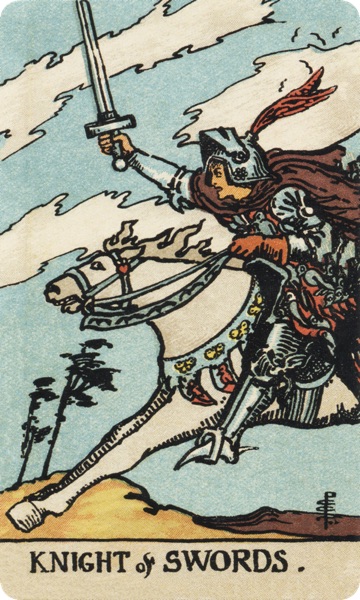
The Rider-Waite-Smith image shows an armored rider charging forward on a horse with a raised sword. The public-domain Commons image is used here for visible facts only. Symbolic meaning is interpretation unless a named source explicitly supports it.
Historical and suit context
Knight of Swords belongs to the Swords suit, one of the four Minor Arcana suits in this project. The canonical project suit name is Swords. Older cartomantic texts may sound harsher than modern search language, so this article keeps Waite, Biddy, Labyrinthos, and Chatarot interpretation in separate lanes.
In modern tarot practice, Swords are commonly read through thought, conflict, truth, decisions, and communication. That vocabulary is a reading convention and should not be treated as a historical fact about every older Swords source. Swords language can become sharp quickly. The article keeps distress, conflict, and crisis symbolic unless a source is being quoted directly.
Interpretation notes
For court-card readings, Knight of Swords may describe a person, a role, a message, a working style, or a mode of behavior. It should not be reduced to gender, age, or a fixed personality type.
FAQ
What does Knight of Swords mean upright?
Upright, Knight of Swords means Action, courage, change. It usually points to fast action, courage, argument, or a decisive push that needs discipline and context in a way that asks for clearer proportion and context.
What does Knight of Swords mean reversed?
Reversed, Knight of Swords means Recklessness, aggression, conflict. It can show the same Swords theme blocked, exaggerated, delayed, or handled without enough support.
How is Knight of Swords different from nearby Swords cards?
As a court card, the Knight can describe a person, role, energy, or mode of action rather than a fixed age or gender.
Sources and further reading
- Arthur Edward Waite, The Pictorial Key to the Tarot (1910), Wikisource proofread page, https://en.wikisource.org/wiki/Page:The_Illustrated_Key_to_the_Tarot.djvu/124
- Wikimedia Commons: Knight of Swords, Rider-Waite-Smith tarot, https://commons.wikimedia.org/wiki/File:Swords12.jpg
- Biddy Tarot: Knight of Swords Tarot Card Meanings, https://biddytarot.com/tarot-card-meanings/minor-arcana/suit-of-swords/knight-of-swords/
- Labyrinthos: Knight of Swords Meaning, https://labyrinthos.co/blogs/tarot-card-meanings-list/knight-of-swords-meaning-tarot-card-meanings